Sanding Solid Surface Countertops
Sanding Solid Surface Countertops
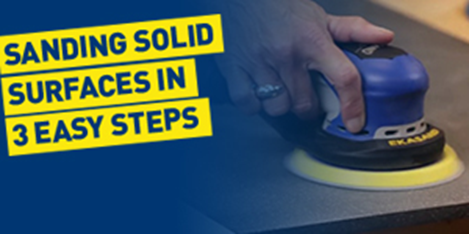
When fabricating solid surface countertops, the final finish can make or break the overall look of the project. Scratches, swirl marks, or inconsistent sheen can quickly take away from an otherwise flawless fabrication job.
The good news? Achieving a consistent finish doesn’t have to be complicated. With the right sanding sequence and tools, fabricators can produce professional results efficiently and consistently.
But is there a quick and easy way to sand solid surface? The short answer is no, like any great finish, it takes time and finesse, but we’ve found this simple sequence Uneeda has tried and tested can save time and still produce a high-quality finish.
Below we’ll walk through a simple 3-step sanding method, along with additional finishing guidance from Direct Supply’s Solid Surface Finishing Guide to help you achieve matte, satin, or gloss finishes.
The Uneeda 3-Step Process for a Matte Finish
One of the fastest ways to achieve a clean matte finish on solid surface countertops is Uneeda’s streamlined 3-step process using EKASILK PLUS sanding sponges.
This simplified approach reduces sanding time while still delivering professional results.
Step 1: First Pass – EKASILK PLUS Fine
Start with the EKASILK PLUS Fine sponge (180–240 finish).
This first pass levels the surface and removes minor imperfections while creating a consistent base for the finishing process.
Step 2: Second Pass – EKASILK PLUS Ultra Fine
Next, switch to EKASILK PLUS Ultra Fine (600–800 finish).
This step refines the scratch pattern and begins to establish the final matte texture.
Step 3: Final Polish – UNEELON White
Finish the process using the UNEELON White polishing disc.
This final step blends the surface and produces a smooth, uniform matte finish across the countertop.
Pro Tip: Always wipe the surface clean between sanding steps to remove loose abrasive particles that can create new scratches.
Bonus: Other Finish options
Maroon Sanding Pad (Scotch-Brite 7447 – Very Fine)
- Light surface refinement – Removes light scratches and sanding marks left from earlier abrasive steps.
- Blends finishes evenly – Helps create a consistent matte finish across the entire solid surface.
- Flexible and conformable – Works well on edges, curves, and seams without gouging the material.
- Controlled abrasion – Cuts enough to refine the surface but won’t aggressively remove material.
- Ideal prep step – Great for preparing the surface before final finishing with a finer pad.
Grey Sanding Pad (Scotch-Brite 7448 – Ultra Fine)
- Final finishing pad – Produces a smooth, uniform matte or satin finish.
- Removes very fine scratches – Refines the surface after the maroon pad for a cleaner appearance.
- Enhances consistency – Helps eliminate swirl marks and uneven sheen.
- Non-woven design – Reduces clogging and allows even abrasion across the surface.
- Perfect for solid surfaces – Ideal for materials like Corian and other acrylic surfaces where a consistent finish is critical.
Understanding the Importance of Grit Progression
Solid surface finishing works best when abrasives move through a consistent grit progression. Each successive grit removes the scratch pattern left by the previous one, gradually refining the surface until the desired sheen is achieved.
Skipping grits can leave visible scratches that require additional sanding time to remove.
Uneeda Solid Surface Sanding Guide
A Simple Guide to Achieving the Perfect Finish