Use of Seaming Adhesives in Cold or Hot Substrates
Use of Seaming Adhesives in Cold or Hot Substrates
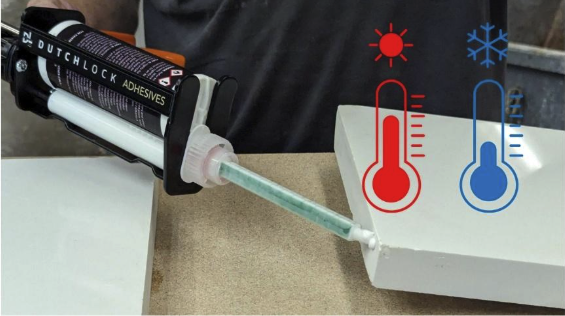
Listed below are some helpful hints for use of 10 to 1 formulated adhesive that will generally give better, more consistent results, and can eliminate areas that are either uncured or cured prematurely, or adhesives that may not even cure at colder temperatures.
️Summer Operations
Seaming Adhesives, in particular, Methyl Methacrylate Adhesives, which are commonly are used in seaming counter tops, such as solid surface, quartz, marble, granite, porcelain or sintered materials are designed to work in controlled environments. The reaction of the resin with the hardener (generally a peroxide, and in Methyl Methacrylate Adhesives), is benzoyl peroxide, creates an exotherm (that means heat generating) reaction. The effect of the exothermic reaction is that energy is given off, generally in the form of heat. So, often, if there are large masses of the adhesive, you might experience a boiling, or popping of the adhesive, as the exothermic (heat) is great enough to cause certain components, like a monomer to boil. This is often found in warmer conditions, or on warm summer days, where there may be an excess of material over seams, or expunged in a trash can to purge the adhesive. It is that heat that creates a good bond of the adhesive to the substrates. Too much heat, and one often experiences boiling, or the yellowing of the seam. It is also the heat that contributes to the strength of the adhesive. Certainly, if bubbling occurs, one might even experience a weaker joint due solely to the high temperature achieved by the adhesive at or near the joint. Therefore, we recommend in high temperatures, such as those greater than 85F, that seaming adhesive is applied not in large masses, but in smaller masses that do not generate much heat. Seaming above 85F can cause some of the less pigmented products to produce a slight yellowing effect. It is important to note that often it is the substrate temperature that is most important. Hotter substrates, such as darker colors, seamed together in the sun, may cause more of this issue, so we don’t recommend seaming about 85F. Should you find that the substrates are hotter than 85F, we recommend that you mist water on the substrate to cool the seaming area down. In general, it may take 30 to 45 minutes of spray water to reduce the temperature below 85F.
Winter Operations
Often, we find that the opposite can be equally detrimental to the bond strength of the seam. Seaming counter tops together in cold weather can create situations where the adhesive isn’t cured properly, and the seam strength or bond strength is insufficient for providing the high-quality seam that customers have come to expect. What is often found, at cold temperatures, less than 65F is that seams don’t seem to cure, and the product remains soft for a long period of time. This becomes especially more evident in temperatures below 50F. Again, the predominant temperature may not be the air temperature, but is the temperature of the substrate, i.e. the material that really defines how cold is the seam. Dense marbles, porcelains, and granites can really hold the cold, and even after a few hours of warmer air temperatures may only move a few degrees in the right direction. If after 30 minutes after application the adhesive is not cured, and you can dig your fingernail in the adhesive, that is a symptom of an incomplete reaction, generally that will be deficient is seam strength. Therefore, we don’t recommend seaming substrates/countertops together in such cold temperatures, less than 50F. Now this is not a hard cutoff temperature, but the closer one gets to 50F or below, the worse the condition. So, how does one seam products that are below 50F. That process involves strip heating the seaming area for an extended period, and the constant application of a radiant heater on the seam area. Infrared heaters are especially good at this, but it isn’t as simple as turning on a heater, and laying down a bead. The substrate generally takes quite a bit of heat to move the substrate into the proper seaming range, generally from one to two hours of prolonged infrared heat on a seam. Some have used heat guns, but the fabricator MUST be careful, with any of these added techniques as these adhesives are all flammable, and good care and caution must be exercised when used a heating source with a flammable liquid. A warm heat soak of an hour with an infrared heater on the seam would be sufficient enough to heat the seam to handle the application of the adhesive, thereby giving the fabricator enough time, and the adhesive enough of a window to react properly, and form the strength necessary to bond the substrates together.
616-245-4415
Please don't hesitate to contact us with any questions or comments.
Use of Adhesives on Cold or Hot Surfaces